

Most leaders believe they make decisions rationally.
We weigh the data. We consider the options. We think about the team, the organization, the mission. We tell ourselves, and others, that we are being logical, strategic, and reasonable.
In fact, we are almost never being logical.
Beneath every leadership decision is a driver. Not a framework or a methodology, but a psychological center of gravity. Something pulling the decision toward a particular outcome before the analysis even begins. Most leaders never name it. Some never even notice it.
This is about naming it. Only then can we do something about it.
Two Questions That Reveal Everything
After years of working with leaders across industries, I’ve found that nearly every significant decision can be traced back to two fundamental questions:
Who is this decision really for? Is it for you, your reputation, your legacy, your sense of control? Or is it genuinely for the people around you, your team, your organization, the people you serve?
What reality is it based in? Is it grounded in a clear-eyed read of what’s actually true? Or is it perceived through fear. It could be fear of failure, of exposure, of loss or through something like wishful thinking that inflates what’s possible.
These two questions form a matrix. And where you fall on that matrix, more than any skill or strategy, determines the impact of your leadership.
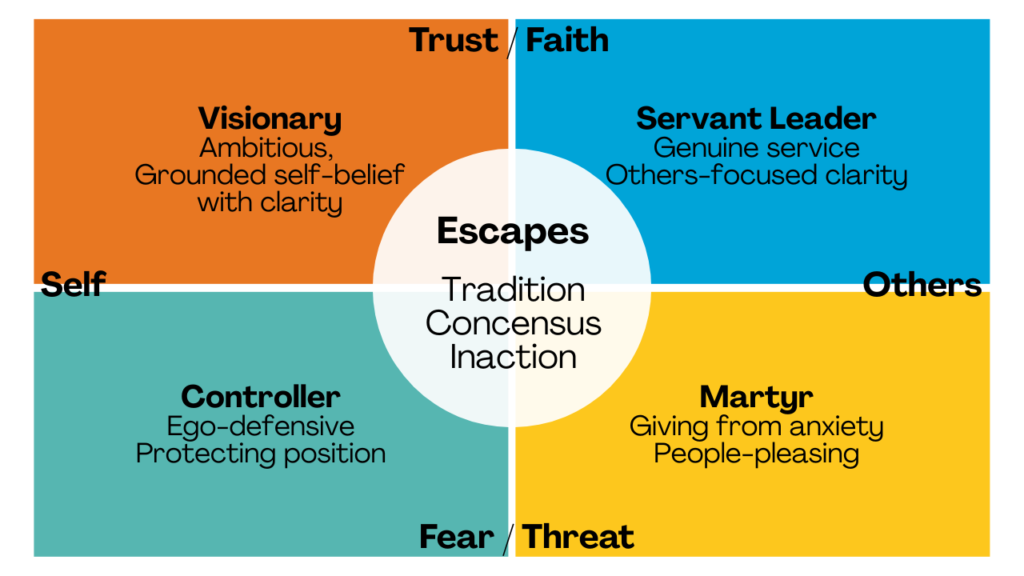
The Decision Mirror – The Four Drivers. Author and Creator, Lana Hailemariam, CEO, StandUP.
The Four Drivers
Quadrant One: The Visionary (Self + Trust)
This leader makes decisions from a place of confident self-belief, grounded in reality. They are ambitious, yes, but their ambition is anchored. They know what they stand for, they have a clear read on the landscape, and they trust their own judgment enough to move decisively.
The shadow side of this quadrant is worth naming: self + trust can slide into arrogance when the leader stops questioning their own read on reality. Confidence without feedback loops creates blind spots.
At its best, though, this is the leader who can hold a vision steady when others waver, not because they’re ignoring risk, but because they’ve genuinely reckoned with it.
Quadrant Two: The Servant Leader (Others + Trust)
This leader makes decisions in genuine service of others, their team, their organization, the people they’re accountable to, and does so from a place of clarity rather than anxiety.
This version of service isn’t inherently virtuous. Yet when service is paired with a grounded read on reality, decisions tend to be both generous and wise. The leader isn’t trying to be liked. They’re trying to be useful.
This is also the hardest quadrant to stay in. Life and leadership apply constant pressure. The question isn’t whether you can get here. It’s whether you can stay here.
Quadrant Three: The Controller (Self + Fear)
This leader makes decisions that protect their position, their reputation, or their sense of control usually without fully realizing that’s what they’re doing.
The Controller doesn’t experience themselves as defensive. They experience themselves as standards-driven, decisive, and appropriately skeptical. They use language like “accountability” and “excellence” and “not being naive.” What they are actually doing, is managing their own anxiety by managing the people and circumstances around them.
This is one of the most common leadership patterns and one of the most damaging because it disguises itself as something else.
Quadrant Four: The Martyr (Others + Fear)
Here is where most frameworks get it wrong. They assume that because this leader is focused on others, they must be in good shape. Not necessarily.
The Martyr gives relentlessly, visibly, exhaustingly but the giving is driven by fear. Fear of conflict. Fear of being seen as selfish. Fear of what happens if they stop. They say yes when they mean no. They absorb what they should redirect. They sacrifice in ways that feel noble but function as avoidance.
The tell is this: genuine service feels energizing, even when it’s hard. Martyr-giving feels like debt. And eventually, the Martyr either burns out or quietly (or loudly) begins to resent the very people they’re sacrificing for.
The Escape Hatches
Here’s the part nobody talks about.
Most leaders aren’t cleanly in any quadrant. Most leaders hang out in the center more than they’d admit. They might believe they’ve achieved some perfect balance, when they’re actually avoiding the discomfort of knowing which quadrant they actually occupy.
The escape hatches look like this:
- Tradition “This is how we’ve always done it.” The past makes the decision so you don’t have to.
- Consensus “Let’s see what the team thinks.” Other people make the decision so you don’t have to.
- Inaction “Let’s wait and see.” Time makes the decision so you don’t have to.
None of these are inherently wrong. Tradition carries wisdom. Consensus builds alignment. Patience can be strategic. It’s when they become defaults, when a leader reaches for them not out of wisdom but out of avoidance, that they become escape hatches. They are ways of staying comfortable without ever confronting the question of what’s actually driving you.
The Real Question
Here’s the tension at the heart of this framework:
You may believe you are in the top half of this model. You might believe your decisions come from clarity. Either confident self-direction or genuine service to others. You probably tell yourself a story about yourself that confirms it.
But the Controller doesn’t know they’re the Controller. The Martyr doesn’t experience their giving as fear-driven. And the leader camped out in the escape hatch genuinely believes they’re being collaborative, respectful of the past, or appropriately cautious.
The question isn’t which quadrant you aspire to.
The question is which quadrant you’re actually in right now, in this decision, in this season of your leadership.
That requires something most leadership development skips entirely: not more strategy, not more frameworks, but honest self-examination. The willingness to look in the mirror and ask, “Is this decision for me, or for them? Is it based on what’s real, or what I’m afraid of?”
How to Use This
You don’t have to audit your entire leadership history.
Think of a significant decision you’re currently facing or one you recently made. Ask yourself honestly:
- Who does this decision most benefit?
- What am I afraid would happen if I chose differently?
- Am I reaching for tradition, consensus, or delay because it’s wise or because it’s easier?
The answers won’t always be comfortable. That’s the point.
The leaders who get this right aren’t the ones who always operate from the ideal quadrant. They’re the ones who know which quadrant they’re in and who have the honesty and the courage to course-correct when it matters.
At StandUP, we call this framework The Decision Mirror. It’s a model for understanding what’s really driving your leadership decisions. If this resonated, I’d love to hear which quadrant you recognize most in yourself or in the leaders you’ve worked with or for. We’d love to be a thought partner!


Related Posts
Don’t Cut What Counts: What Happens When You Cut the Wrong Corner?
August 15, 2025
When budgets get tight, leaders are challenged to do the same great work as before only with fewer resources. This typically...
Your Comfort is Slowing You Down
December 8, 2025
Your Comfort is Slowing You DownOne of the greatest risks to professionals 40+? Letting your comfort zone become your...